




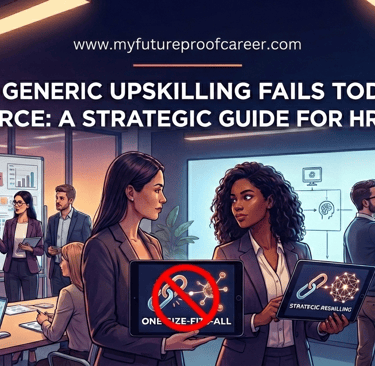
Generic Upskilling Fails Today’s Workforce: A Strategic Guide for HR Leaders
In a world where things are changing faster and faster, training has never been more important. Yet most training programs offer old, outdated, one-size-fits-all methods. This is a disaster for HR professionals tasked with ensuring an organization's personnel is properly trained. This article covers what you, as a proactive HR leader, can do to ensure your organization thrives in this environment by enabling your personnel to become future-proof.
Neal Greenspan
6 min read

My post content
HR and L&D leaders today face a unique and difficult challenge.
You are being asked to equip your workforce with the skills they need to thrive in a rapidly changing world of work. Yet, the solutions being offered often feel familiar. One-size-fits-all (OSFA) programs that promise results but rarely deliver them.
The uncomfortable truth is that most workforce upskilling training programs fail because they assume employees are starting from the same place, have the same goals, and can absorb the same content in the same way. They don’t. And that misalignment comes at a real cost: wasted budgets, uneven performance, disengagement, and stalled organizational growth.
This post is about changing that. It’s about giving HR leaders the clarity to recognize why generic training fails, how human skills fit into the AI-driven future, and how to design reskilling strategies that actually build organizational capability.
The Changing Landscape of Work
AI and automation are no longer distant threats. They are reshaping hiring, eliminating roles, and quietly redefining what “qualified” means. Many European organizations are already seeing this: job descriptions evolve monthly, hiring criteria shift toward hybrid human-technical skill sets, and performance expectations are increasingly tied to adaptability, not just outputs.
Organizations are investing in technology and training to keep pace. But investing in generic training alone is like filling a bucket with a hole at the bottom: activity looks good on paper, but results leak away before they create meaningful capability.
The question is not whether your employees need new skills or need to improve those they already have. They do. The question is whether your training programs are actually helping them build the right skills, and that starts with diagnosis, not instruction.
Why One-Size-Fits-All Programs Fail
Many workforce upskilling training programs focus heavily on technical skills or tools. Courses are easy to scale, completion metrics are easy to report, and the investment looks justified.
But here’s the problem: technical knowledge alone is not enough. What truly separates high-performing employees in today’s world of work are human skills that AI cannot replicate:
Clear thinking in ambiguous situations
Strong, effective cross-functional communication
Sound judgment when there is no obvious answer
Team building and leadership
Adaptability and resilience in changing environments
Consider this scenario: a team of 20 customer support specialists completes an AI-powered data analysis training program. They all pass the assessments, and HR sees 100% completion. But when a real customer issue arises requiring judgment across data, client needs, and internal policy, only a handful of employees know how to act. The investment looks good in reports, but the business impact is minimal.
When training programs ignore these human skills, employees may complete courses, but organizations rarely see measurable improvement in performance. Teams remain siloed, decisions falter, and talent loses confidence in the learning initiatives you offer.
Another issue with OSFA training is that two people, in the same department of the same company with the same job title do NOT have the same gaps, needs, and goals. Thus putting them through the same exact training is a waste of time, money, and demoralizing.
The Organizational Cost of Ineffective Upskilling
Generic programs create the illusion of progress. HR sees engagement metrics. Leadership sees participation. Yet the real outcome, capable, adaptable employees, is often missing.
The hidden costs include:
Wasted training budgets: Courses are purchased, licenses are active, yet tangible capability gains are uneven
Slower time-to-productivity: Employees spend hours completing programs that don’t help them solve real problems
Bottlenecks in internal mobility: Employees may be qualified on paper but unable to perform in new roles
Lower retention and engagement: When learning feels irrelevant, you end up with disengaged employees who are more likely to seek a new role elsewhere
Talent misalignment with strategic priorities: Workforce development becomes reactive instead of strategic
Even well-intentioned programs can leave employees frustrated, unclear about how to apply their learning, and unsure which skills truly matter.
Real-World Examples from European Organizations
Take a mid-sized Swedish tech company investing in AI adoption. They ran a company-wide “AI literacy” program. Everyone learned the same toolset, regardless of their function. Developers, project managers, and HR staff all followed the same curriculum. Completion rates were high, but months later:
HR teams struggled to hire for new hybrid roles because employees lacked judgment on what problems AI should address
Project managers found they could not prioritize initiatives effectively
Developers applied the tools in isolation, creating duplication and wasted effort
The root problem was not the employees. It was the one-size-fits-all design. The program assumed all roles had the same skills gap, and ignored the human skills required to turn knowledge into results.
This example is not unique. Across Europe, OECD and WEF studies show that companies investing in generic upskilling see little change in actual workforce capability. (see links to these studies at the end of this article)
What Works: Diagnosis-First Workforce Training
The most effective approach is diagnosis-first training. Before sending employees into courses, organizations need to identify:
How roles are evolving in the age of AI
Which skills are mission-critical for team and organizational success
The capability gaps that exist today
Priorities for individual and group development
Targeted workforce upskilling training aligns learning to these real gaps, creating measurable improvements in both individual capability and organizational performance.
For example, a European financial services company mapped its team capabilities against future-facing business needs. They identified:
Junior analysts needed stronger judgment and problem framing skills
Mid-level managers needed cross-functional communication and decision-making training
Senior managers needed strategic foresight and change leadership
Instead of sending everyone through the same AI or data course, the company created a layered, role-specific training plan. The result: accelerated adoption of AI tools, higher team collaboration, and measurable performance improvements in six months.
Employees became confident because they understood why they were learning, how it applied to their role, and what to focus on first. HR gained measurable ROI, and the organization became more adaptable to change.
Human Skills vs. Technical Skills: A New Reality
It is tempting to think that upskilling and reskilling is primarily about learning new technical tools. Many corporate training programs reinforce this idea, emphasizing AI tools, data platforms, or software applications.
The reality is more nuanced:
Technical skills matter - But more and more, they are short-lived and not useful for everyone in an organization. A tool that is in demand today may be obsolete in two years
Human skills endure - The ability to communicate effectively, make judgment calls, and adapt to changing circumstances is what differentiates employees long-term. Learning how to motivate a lead a team, especially in turbulent times, will never cease being important
In other words, organizations that focus exclusively on technical skill acquisition risk creating a workforce that is competent on paper but not capable in practice.
Balancing Individual and Organizational Perspectives
While this guide is aimed at HR and L&D leaders, employees within your teams matter too. When individuals see the connection between targeted training and their role, they engage more deeply, learn faster, and contribute to business outcomes.
Your role is to create that connection, not to dictate it. Diagnostic-first upskilling programs bridge the gap between organizational priorities and individual growth, creating a workforce that is both capable and motivated.
Think of it this way: you can buy the best courses in the world, but without clarity on who needs what and why, those courses are just content. The real value comes when content is applied strategically.
Strategic Takeaways for HR Leaders
Stop treating employees as generic learners: Map skill gaps role by role. Identify where human skills are lagging, not just technical skills
Measure outcomes, not activity: Completion rates are vanity metrics. Look at performance improvements, role readiness, and business impact
Invest in diagnostic-first programs: Prioritize clarity before instruction. Focus on what employees actually need, not what looks trendy
Align with strategic workforce planning: Upskilling should support business goals, not just feel like a checkbox
Integrate feedback loops: Continually measure, learn, and adjust programs based on real-world performance
These steps ensure training is not just delivered but transformed into capability. That the training programs will provide the necessary learning to increase skill levels for each individual, making your entire team more valuable and future-proof. Very little is more important in the world of work of 2026 and will continue to be in the years ahead.
Moving Forward
The key takeaway is simple but often overlooked: more training is not always the answer. What matters is the right training applied to the right people at the right time.
If your organization is still relying on generic workforce upskilling training, now is the moment to rethink the approach. Strategic reskilling in the age of AI is not a luxury, it’s a necessity.
Resource links:
Generic Upskilling Fails Today’s Workforce:
A Strategic Guide for HR Leaders
Stay relevant in the fast-paced, ever-changing job market and set yourself up for a long, rewarding, future-proof career.
My Future-proof Career
neal@myfutureproofcareer.com
© 2025. All rights reserved.