



The Myth of "Future Skills Lists"
At the end of or perhaps the beginning of each year, countless lists are published touting the top skills everyone will need to remain valuable in the disruptive world of work. While these lists are not completely without merit, blindly following them is akin to driving off a cliff while staring at a map of the moon. This article shows why these lists should not be taken as the only input when deciding what skills people should be trained on. It outlines the process to ensure the right people get the right training on the right skills for them.
Neal Greenspan
5 min read
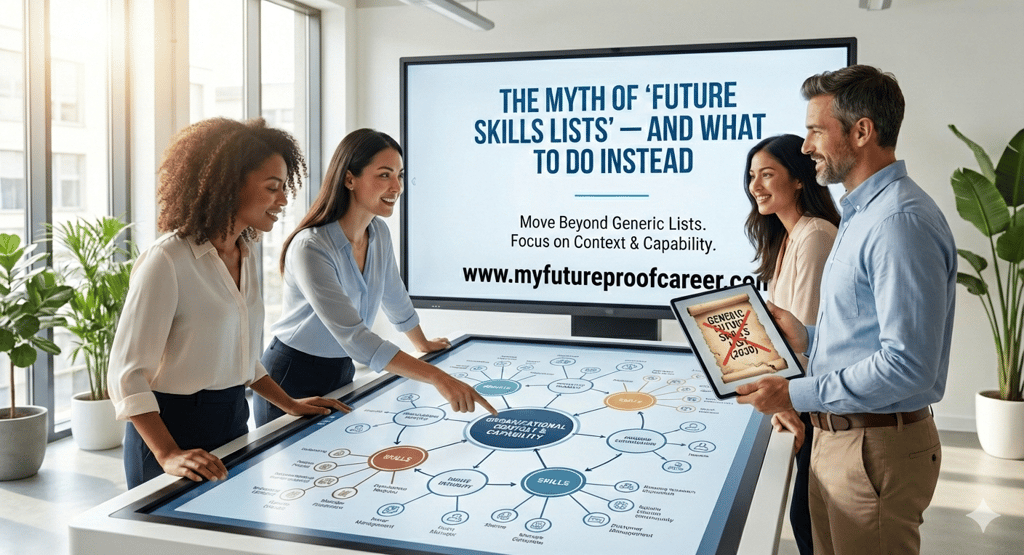
The Myth of “Future Skills Lists” - And What to Do Instead
Every year, HR leaders are presented with the same empty promises.
These promises come in the form of lists with titles like:
The Top Skills Your Workforce Will Need by 2030
The Most In-Demand Skills for the Future of Work
The Skills That Will Make Your Organization AI-Ready
These lists are everywhere. They are well designed, widely shared, and often backed by reputable sources. In a time of uncertainty, they feel reassuring. They suggest that if you know the right skills and train your people accordingly, you can prepare your organization for whatever comes next.
Unfortunately, that confidence is often misplaced.
The problem with future skills lists is not that they are wrong. Many of the skills they highlight are reasonable and, in isolation, important. The problem is that static skills lists create false confidence, and false confidence is one of the most dangerous positions an organization can be in during a period of rapid change.
This article explains why future skills lists fail, how they quietly undermine workforce development efforts, and what HR leaders can do instead to build real, durable capability in the age of AI.
Why Skills Lists Are So Appealing to HR Leaders
They are familiar, easy to digest, and feel like a warm cup of tea in the cold, uncertain world of work.
AI and automation are reshaping roles faster than most organizations can redesign jobs, career paths, or training frameworks. HR leaders are under pressure to act. Boards want reassurance. Executives want plans. Employees want clarity.
Skills lists offer all of that in a neat package.
They are easy to communicate
They feel actionable
They scale across large organizations
They provide something concrete to point to when asked, “What are we doing about the future of work?”
From the outside, they look like progress.
But clarity is not the same as capability.
The False Confidence Problem
The biggest risk of future skills lists is not that they are incomplete. It is that they signal closure.
Once a list exists, many organizations move quickly into execution mode:
Training programs are built around the list
Employees are enrolled in relevant courses
Completion rates are tracked
Dashboards are shared with leadership
On paper, the organization is “upskilling.”
In reality, very little is changing.
Employees often complete training without knowing how to apply what they learned. Managers still see the same performance gaps. Teams still struggle with prioritization, judgment, and decision-making in complex situations.
This is the same dynamic explored from an individual perspective in the article, “Why ‘One-Size-Fits-All’ Career Advice is a Disaster in the Age of AI and Automation”
At the organizational level, the cost is even higher. Time, money, and credibility are spent without a corresponding increase in capability.
That is false confidence.
Here is the core flaw most skills lists ignore:
A skill has no value outside of context.
Critical thinking means something different in a frontline operational role than it does in a leadership position. Communication skills look different in HR, engineering, sales, and compliance. Even technical skills vary dramatically depending on industry, maturity, and strategy.
Yet future skills lists treat skills as if they are universal and transferable by default.
The World Economic Forum’s Report on Jobs repeatedly emphasizes that skill demand varies not just by industry, but by role and organizational context.
When skills are abstracted from context, they become labels rather than capabilities.
A Scenario Many HR Leaders Will Recognize
Two employees complete the same training on “strategic thinking.”
One works in a frontline operational role. The other is a senior project manager.
Both pass the assessment. Both are now considered “upskilled.”
Months later, under pressure:
One struggles to prioritize tasks when conditions change
The other struggles to align stakeholders and make tradeoffs
The skill name is the same. The gaps are entirely different.
This is not a failure of learning. It is a failure of diagnosis.
The Organizational Cost of List-Driven Upskilling
Generic workforce upskilling training creates the appearance of progress without delivering results.
According to PwC, many organizations invest heavily in reskilling but struggle to see measurable improvements in productivity and performance - https://www.pwc.com/gx/en/issues/upskilling/reskilling.html
The hidden costs include:
Training budgets spent on low-impact programs
Slower time-to-productivity in evolving roles
Bottlenecks in internal mobility
Lower engagement as employees sense irrelevance
Growing skepticism toward HR initiatives
This reinforces a pattern already highlighted in:
https://www.myfutureproofcareer.com/dont-wait-for-ai-to-change-your-job-why-proactive-reskilling-is-the-only-path-forward
More training is not the same as the right training for the right skills for the right person.
Why AI Makes Skills Lists Even Less Reliable
AI accelerates change, which makes static lists age poorly.
New tools appear faster than frameworks can be updated. Roles evolve continuously, while skills lists are revised annually at best. Organizations end up chasing relevance rather than building it.
The OECD has warned that rigid skills frameworks struggle to keep pace with technological and labor market change.
https://www.oecd.org/skills/outlook/skills-outlook-2023/
In this environment, human capabilities like judgment, adaptability, and problem framing become more important, not less. Yet these are precisely the capabilities least suited to checklist-based approaches.
What High-Performing Organizations Do Instead
Organizations that succeed with employee reskilling in the age of AI take a different path.
They do not begin with skills lists. They begin with inquiry.
They ask:
How is our business model evolving?
Which roles are changing most rapidly?
Where does performance break down today?
What decisions do our people struggle to make?
What distinguishes our strongest performers?
Only after answering these questions do they define which skills actually matter.
They then make sure that individuals receive the training most relevant to them. Even two people sitting next to each other with the same title don’t necessarily need the same training.
MIT Sloan research consistently shows that organizations focusing on capability and decision-making outperform those focused narrowly on skills acquisition.
https://sloanreview.mit.edu/article/why-skills-based-hiring-isnt-enough/
This shift from listing skills to understanding capability is subtle but decisive.
Diagnosis Before Development
Effective workforce upskilling training starts with diagnosis.
That means identifying:
Role-specific demands
Individual strengths and gaps
Organizational friction points
Misalignment between learning and real work
Gartner’s research on skills-based organizations highlights the importance of understanding skill application, not just skill possession.
https://www.gartner.com/en/human-resources/topics/skills-based-organization
Diagnosis takes time. It requires conversations, data, and sometimes uncomfortable truths. But it produces clarity, and clarity is what allows learning to translate into performance.
Where Individuals Fit Into This Picture
Although this article is written primarily for HR leaders, individuals experience the consequences of skills lists directly.
Employees are often told what skills matter without understanding why. They are encouraged to upskill broadly, without guidance on where to focus. Many invest time and effort only to feel no more secure than before.
When organizations adopt a diagnostic-first approach, individuals gain:
Clear priorities
Confidence in where to invest effort
A sense of agency over their development
This alignment between organizational strategy and individual ownership is what makes workforce development sustainable.
What to Do Instead of Relying on Skills Lists
For HR leaders ready to move beyond the myth, here are practical shifts to consider:
Treat skills lists as hypotheses, not answers
Define skills through real behaviors and decisions
Segment your workforce by role, context, and risk
Measure performance outcomes, not participation
Revisit assumptions regularly as roles evolve
Harvard Business Review has repeatedly emphasized that capability, not content, is what drives long-term performance.
https://hbr.org/2019/07/why-upskilling-your-workforce-is-not-enough
This approach is slower and more demanding. It is also far more effective. It will ensure that you are not spraying training options like a stormtrooper sprays laser beams all over a scene in Star Wars. There's plenty of laser, but not much is hitting the target. This approach will ensure your efforts are on target and provide the most relevant training for your personnel.
A Final Reality Check
There is no single list that will future-proof your workforce.
Anyone promising certainty in this environment is selling comfort, not capability.
Building a resilient organization takes effort, honesty, and time. It requires letting go of shortcuts and investing in understanding how work is actually done.
But the payoff is real.
Organizations that move beyond static future skills lists build workforces that can adapt, decide, and perform in conditions that cannot be predicted in advance.
The Bottom Line
Future skills lists are not useless. They are simply insufficient.
When treated as answers, they create false confidence. When treated as conversation starters, they can be helpful.
The future of work belongs to organizations that understand which skills matter, for whom, and in what context.
That understanding does not come from lists.
It comes from diagnosis.
And if you need help with the diagnosis process, My Futureproof Career has plenty of tools.
Stay relevant in the fast-paced, ever-changing job market and set yourself up for a long, rewarding, future-proof career.
My Future-proof Career
neal@myfutureproofcareer.com
© 2025. All rights reserved.